Why is the language of the brain so much easier to understand than the language of the heart? The brain has an unfair advantage, of course--it speaks in words, in concrete images. The languages we use every day to engage with other people. The brain stores information, and it warns us to stay out of traffic, or keeps us from putting our hands down on hot stoves. Its practical value makes the brain cocky. It believes its own hype and so do we. If it's wise enough to tell us that we shouldn't burn our hands, surely it should be listened to in all other situations, right?
But keeping our hands away from flames isn't wisdom. It's only common sense. Despite its clear, blunt communication tactics; its loud voice; its brute strength; its stash of facts, the brain is often misguided. It panics, it jumps forward and backward in time. It's afraid of pain. It's afraid of what other people will think. It's afraid, ironically, of making wrong decisions.
It's afraid of the wrong things. And mine resents me for even writing that.
My heart knows better. My heart, after all, knows what's in my heart. And my heart's signals are as clear as my brain's, but they take different forms and I'm less practiced at reading them. There are physical signs when my heart knows a decision is wrong--crying I can't control, nausea, pain or coldness, awful electric shocks of anxiety at the very idea of settling on a particular decision. Or more subtle discomforts. Just...a feeling that something isn't right.
And you would think it'd be easy to pay attention. If something feels bad, why would I want to do it? But if the right decision might cause extraordinary pain, my brain is all in favor of living with my heart's discomfort, and it mounts the most amazing arguments in favor of a bad decision. In favor of ignoring my heart. And any time my heart is conflicted, my brain leaps in to fill the gap, to "take care of" things. And it's loud, it's a bully--it drowns out my heart as much as it can; it tells my heart it's naive or foolish or cowardly. And so my heart is often beaten down by my brain.
But ignoring my heart isn't wisdom. It's not even, it turns out, common sense. It always, always ends up being tremendously painful, in a way that's much harder to recover from than the pain of missing out on something potentially great, or the pain of necessary loss, or whatever other clean, pure pain the brain is trying to avoid.
So how to learn? How to learn to quiet my brain so I can listen to my heart or give it time to reach a decision? How to learn to calm the brain's fears, to comfort it enough that it's willing to work together with my heart?
How to keep myself whole?

Showing posts with label fear. Show all posts
Showing posts with label fear. Show all posts
Wednesday, July 17, 2013

Monday, September 3, 2012
Challenge Versus Ease
I'm a little homesick--for Annie and Tigger; and for dry, clear air; and for the wide fields and the hills off in the distance; and the fruit trees everywhere. I walked into a Whole Foods the other night and was greeted by a small basket of figs for sale--figs from California, of course; figs just like the ones that are probably currently ripening on the tree just behind the abundant garden I worked so hard to plant and left behind; figs that are ripening just in front of the two pomegranate trees that will still have a month or two to go before the arils burst the skins of the fruit.
But yesterday I walked past an apple tree someone had planted in front of their house. I don't remember seeing fruit trees anywhere in the city as a child. My grandfather's house in western Pennsylvania had apples, and the farm in upstate New York, where I lived right after college, had an incredible old apple tree with some of the most delicious apples I've ever eaten. Those seemed like the height of luxury--food! Growing right outside the door! California, with its abundance of edible landscaping--figs, pomegranates, plums, rosemary, cherries, apricots, pluots, blackberries...all just hanging out in city parks--seemed unreal and magical. Easy.
I have a hard relationship to easy. I'm never sure where the balance is for me: When is easy a good thing? When does it alleviate unnecessary difficulty, suffering even, and when does it begin to cross the line into facile and soul deadening?
This city is a hard place for me to be, in many ways. There are ghosts, emotional baggage. The weather here is terrible for me this time of year--not in an "I'm a delicate flower" way, but really, really hard. Atypical seasonal affective disorder hard. By the time I left for work one day last week, I was crying in my car, so rattled I couldn't even drive. My body was so physically miserable I could barely function, let alone maintain emotional balance. All I wanted was to be in the Central Valley, where it's dry as a bone and the mornings are cool, even in the height of summer.
The thing is, there are plenty of things I don't love back there. It took me years to stop being upset by the soulless architecture of most of Davis. The strip malls everywhere. The perfectly landscaped lack of wildness. The brutal sun in the middle of a summer day. The lack of public transit (I took a train to Center City Philadelphia yesterday, and it was blissful).
No place is perfect. If there's a town that is ideally tailored to me, I've yet to meet it. I seem to keep making choices that end up challenging me one way or another, and that certainly sounds like a good thing on paper. But I'm not sure how to keep challenging choices from tipping from healthy and nourishing into extreme discomfort. But then I also wonder if maybe I'm just a challenged sort of person, always--maybe as a category of feeling it's related to the longing Lis wrote about. Maybe extreme discomfort is just part of the package, and maybe there's some cosmic lesson I'm meant to learn from that occasionally ease-less package.
In any event, despite my uneasy relationship with the kind of discomfort I'm feeling right now, my relationship with ease is, perhaps, even less easy. In some ways, certain choices have felt just as much about rejecting ease as accepting challenge. Is that just an adolescent distrust, a need to prove something to myself? Or is it actually a kind of self preservation?
I want a life that's rich and nuanced and faceted. Ultimately, I guess what I really want is beauty and soulfulness and deep search and discovery. To the extent that those things are compatible with ease (and lack of humidity and heat--is that really too much to ask?), I'll take some ease, but apparently I'm unwilling (unable, even) to take ease if it means a lack of the other things.
Meanwhile, this view out my office window is some solace in the middle of the discomfort of homesickness and sticky warm wetness. Rain glistening on slate and Wissahickon schist.

Wednesday, August 29, 2012
•artichokes•
I told Penn "True Blood" is not a movie. It is a television show about artichokes.

Later, amidst the usual bedtime tears, my suddenly-five-year-old wanted to know,
"Are you gonna watch an artichoke show? I don't like artichokes, but if they're not going in my mouth I want to see it." Then, "You get to watch stuff and I don't!"
Well, yeah. And perhaps the eventual slumber of a five-year-old is better for it.
Recently, a friend lamented having showed her daughter an animated film about dragons. The movie introduced the verb "killing" into the toddlers vocabulary. Another friend, the mother of a boy who I've credited with teaching my son the art of constantly pretending to have a gun in his hand, recently mentioned that her husband is very anti-gun. So. File all of this under no-matter-what-we-do? We've tried to relax about the gun obsession, in an effort to give it as little energy as possible. And we've started "Movie Nights" with Penn, in an effort to have a little bit of popcorn-riddled fun. A part of me wonders what he would be like, raised instead in the woods with hand-hewn chess pieces on a stump covered in checker-board moss. That I painted on, chia-ball style. What if. What if we raised our child with select omissions? No guns, killing, Darth Maul, black teeth, poison, or even that bad man who sent the planes with the bombs.* What would a five-year-old Penn be like, without his tart awareness of the world? Awkward though it may be, it's an awareness.
Just musing. What is it that you wish you'd kept to yourself? For just a little longer?
xox
*Penn's description of Hitler.

Later, amidst the usual bedtime tears, my suddenly-five-year-old wanted to know,
"Are you gonna watch an artichoke show? I don't like artichokes, but if they're not going in my mouth I want to see it." Then, "You get to watch stuff and I don't!"
Well, yeah. And perhaps the eventual slumber of a five-year-old is better for it.
Recently, a friend lamented having showed her daughter an animated film about dragons. The movie introduced the verb "killing" into the toddlers vocabulary. Another friend, the mother of a boy who I've credited with teaching my son the art of constantly pretending to have a gun in his hand, recently mentioned that her husband is very anti-gun. So. File all of this under no-matter-what-we-do? We've tried to relax about the gun obsession, in an effort to give it as little energy as possible. And we've started "Movie Nights" with Penn, in an effort to have a little bit of popcorn-riddled fun. A part of me wonders what he would be like, raised instead in the woods with hand-hewn chess pieces on a stump covered in checker-board moss. That I painted on, chia-ball style. What if. What if we raised our child with select omissions? No guns, killing, Darth Maul, black teeth, poison, or even that bad man who sent the planes with the bombs.* What would a five-year-old Penn be like, without his tart awareness of the world? Awkward though it may be, it's an awareness.
Just musing. What is it that you wish you'd kept to yourself? For just a little longer?
xox
*Penn's description of Hitler.
Monday, June 4, 2012
Note to Self II
All those things you're holding onto, all those things you love?
Sometimes, when you ask the universe for something more, something bigger, the thing you'll get back will be such a large possibility, so much more than you'd imagined you were asking for, that you'll need to put down all the things you're holding in order even to attempt to pick up this new gift.
If you manage to pick it up, the new gift will wreck some very good ideas, some very beautiful plans, at least for now. And even trying to pick it up will require the willingness to walk away from something so precious your heart will break at the very possibility.
Remember that holding onto the precious thing requires making a choice that will keep you stunted. Remembering that won't keep your heart from breaking, but it might save you from making the small choice.
Thursday, January 5, 2012
Force Nothing
2011 was not the year I thought I’d have when it began. Funny how that happens, although, to be honest, I’m not sure I could tell you exactly what I thought it would look like. Despite that, it was undeniably a year I needed to have, and it has been, perhaps, the most complicated and nuanced year I’ve experienced. It was horrible, and it was very, very wonderful, and it was everything in between, and it certainly changed the course of my life.
(Not a small stone. [Uh, clearly.] This is actually the column I wrote for this month's issue of the newsletter I edit. I felt the need to put it here too, but I needed to wait for the newsletter to be published and distributed. It's been a week, so I've decided the rights revert to me...now! And as careful readers will already know, the lovely Peaceful Peacock, Julie, read this a few weeks back and basically said, "Your word is right there: Miracles." And so it was.)
A year is long, and a year is no time at all—just a series of weeks, really, and those are just a series of days when it comes right down to it. And in the blink of an eye, the utterance of one sentence, the course of a day, a moment of insight, everything can change. The year and our lives turn on the smallest moments, singular points in time that may or may not be visible to us after the fact. They’re little cliffs, and we’re constantly leaping.
Leaping off of cliffs this year left me, as it always does, with work to do. There are always cliffs, and there’s always work to be done—but this year, the work in front of me is clearer than usual.
You know how some people choose a word for their year? Something they’d like to focus on, a concept or attitude they’d like to incorporate more fully into their lives. I imagine that when you make such a choice, you see your word everywhere, in everything; every moment becomes an opportunity to practice your word in some way, to draw your focus gently back to the growth you’d like to see in yourself, the work you’d like to be doing.
I’ve never done this. There are so many possible words to work with—which one to choose? Do I have to choose just one? The trick, of course, is to find the word that best works as an umbrella for all the things I’m feeling and thinking about.
There’s an Adrienne Rich poem called “This is My Third and Last Address to You,” and it’s quite long, but really, what I’ve always loved most in it are five stanzas somewhere in the middle. And if you are facing any sort of change or growth—especially if it’s the kind that makes you uncomfortable or impatient, this particular stanza may speak to you as it always does to me:
force nothing, be unforced
accept no giant miracles of growth
by counterfeit light
Is there a word that will stand in for that stanza, that will serve as the umbrella word for my year? Patience is part of it, but I’m reaching for something deeper. A sort of quiet understanding and compassion for myself and others: We all take the time we take to get where we’re going, and we can’t be hurried along. Nor can we be stopped or slowed when movement and growth are really happening—and movement and growth are usually happening, right under the surface, even when we feel as if we’re slow as molasses. Slow is not stagnant.
There’s never any time to waste, and simultaneously, there’s always all the time in the world. A new year comes, just as they always do, right when it’s meant to. We may think we’re not ready, but we are. We may think we know what this new year will hold, but we never do. All we can do is adjust our focus once again, resolve to force nothing, and know that as long as we aren’t letting ourselves stagnate in fear or resistance, then we’re growing, moving forward, making progress. The work we each have to do, when we take the time to know what it is and learn how we might go about it, can be joyful and fulfilling—even in the moments when it’s hard or painful. Because deep work, the work of growth and change, is always as complicated and nuanced as an entire year.
And somewhere in this year, as in every other year, there will be those moments when the world shifts, and everything changes, and we leap off our little cliffs, and that joyful, painful work we’ve been doing (slowly, so slowly) lands us somewhere we really never expected.
***********
(Not a small stone. [Uh, clearly.] This is actually the column I wrote for this month's issue of the newsletter I edit. I felt the need to put it here too, but I needed to wait for the newsletter to be published and distributed. It's been a week, so I've decided the rights revert to me...now! And as careful readers will already know, the lovely Peaceful Peacock, Julie, read this a few weeks back and basically said, "Your word is right there: Miracles." And so it was.)
Monday, September 19, 2011
Open the Door
You want to know a fantastic antidote to oncoming depression, whatever its source?
Reach out and tell someone how much you love them, the work they do, who they are, what you see in them. Do it because it's true. Do it because they should know. Do it because the moment you do, a door will open up, and you'll see outside of yourself--that place that seems so dark right now. There's incredible beauty and light out there, and when you open that door, the light will never fail to lift your heart and spill in through the opening to get all over you.
Reach out and tell someone how much you love them, the work they do, who they are, what you see in them. Do it because it's true. Do it because they should know. Do it because the moment you do, a door will open up, and you'll see outside of yourself--that place that seems so dark right now. There's incredible beauty and light out there, and when you open that door, the light will never fail to lift your heart and spill in through the opening to get all over you.
Sunday, August 14, 2011
Trust Roots
Is it better for grief to be paired with hope? Or is it best to have none, to hit the bottom hard and in your pain know, at least, that there’s no further down to go? Hope can always fail us eventually: What if the thing hoped for never comes to pass? What if the universe is moving in a different direction than the one you’re longing for? And so grief paired with hope is a perfect breeding ground for fear.
And still, I think I’ll take my grief with hope and do my best to wait, as Adrienne Rich says, "...without sadness and with grave impatience." And to believe that roots lovingly tended can survive a winter under snow and send up green shoots in the spring--whenever spring arrives.

(From "This is My Third and Last Address to You," by Adrienne Rich)
The work of winter starts fermenting in my head
how with the hands of a lover or a midwife
to hold back till the time is right
force nothing, be unforced
accept no giant miracles of growth
by counterfeit light
trust roots, allow the days to shrink
give credence to these slender means
wait without sadness and with grave impatience
here in the north where winter has a meaning
where the heaped colors suddenly go ashen
where nothing is promised
learn what an underground journey
has been, might have to be; speak in a winter code
let fog, sleet, translate; wind, carry them.
Friday, July 29, 2011
•when up is down and down is up•
In spite of the relative bubble of wealth, education and privilege that insulates our little town of Davis, my son's preschool served Otterpops instead of afternoon snack last week. Yesterday, one of his teachers told my husband she believes raw cashews are poisonous (their shells are, but they don't make the raw nut toxic). I'm starting to get a little disheartened.
If you read no other blogpost for the rest of the year, please look at this brilliant one from KristenM at FoodRenegade.com.
If you read no other blogpost for the rest of the year, please look at this brilliant one from KristenM at FoodRenegade.com.
Tuesday, July 26, 2011
•when are they going to come out?•
When you are an adult...
and you find someone you love very much...
like Mommy loves Daddy...
and Catrina loves Laurie...
and Michael loves Karl...
you might want to use your seeds, then, to make a baby...
to start a new family, your own family.
and you find someone you love very much...
like Mommy loves Daddy...
and Catrina loves Laurie...
and Michael loves Karl...
you might want to use your seeds, then, to make a baby...
to start a new family, your own family.
Friday, July 1, 2011
Shattered
Whether or not you choose it, it seems shattering a life is much like shattering anything else.
The initial breakage is utter chaos. Your feet are bare, and there you are, standing in the middle of shards, that cup of coffee you were so looking forward to splattered on the floor, the wall, the table and chair legs. Who knew liquid could travel so far propelled only by the force of a mug hitting the ground? Who knew the pieces of the mug could bury themselves in dark corners, under the china cabinet, in the next room over? Who knew a mug could break into so many individual pieces, each one a memory of the lovely thing you once had?
And that’s the tricky part—the way the mug’s pieces are suddenly so lovely to you. Suddenly, all you can see is the work and love that went into this handmade thing, the investment of time and energy at the wheel and hope in the firings, the beauty of the glaze.
Somehow, in your grief, you don’t remember the hairline fracture that ran through the whole thing—the flaw that meant it was simply a matter of time before the mug broke anyway.
********************
When a favorite mug of mine broke a few years ago, I was devastated. I guess that’s a little odd, but my feelings about mugs run deep—I’ve made many of the mugs I own, and when I'm in my active pottery-making mode, I am, in fact, a little obsessed with the making of them. And while this particular one wasn’t made by me, it was one I loved dearly, and I’m sure most people won’t exactly be able to relate to the level of grief I felt about breaking it. I cried a good bit. I kind of hated myself for losing my grip on the poor thing. And I couldn’t bear to throw out the pieces. I had no idea what I would do with them—the mug was far beyond any hope of repair—but I gathered up as many pieces as I could, washed them carefully, and set them in a bowl on my kitchen counter, where they stayed for about a year and a half.
Over the next few days, I came across a shard or two of the worst kind—the little slivers that get stuck in feet or fingers and make them bleed. There weren’t many left at all—we did a pretty good job cleaning them up. But the ones I found hurt a lot, and they made me so sad all over again.
The other night, I was looking for a photo to use as a new blog header, and I kept opening photographs that were just like those little slivers of stoneware—painful reminders of something I’ve shattered. Unlike the mug, this shattering was done consciously. And somehow, that makes the shards feel that much sharper.
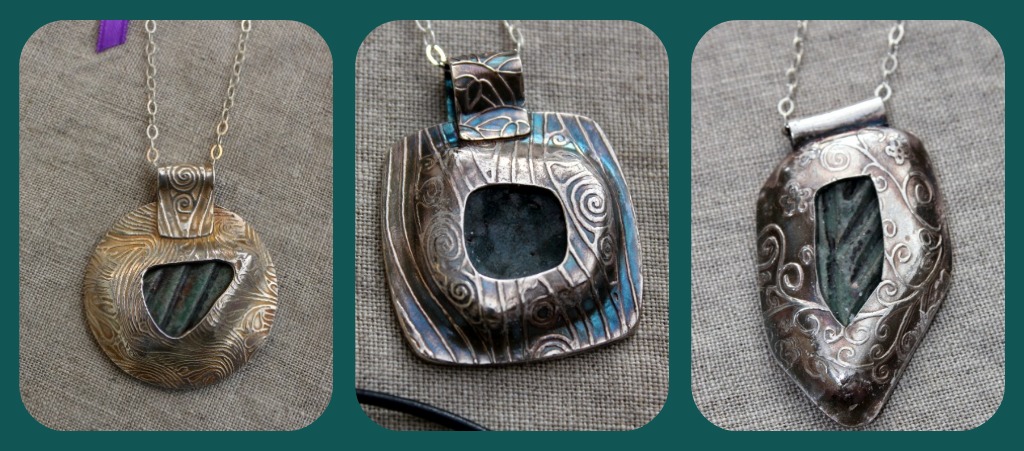
Eventually—just last fall—I had an epiphany about the shards of mug. It occurred to me that stoneware is fired well above the temperature at which I fire silver clay, which meant that I was easily able to incorporate those shards into my jewelry designs. I could create with this broken thing; I could transform the mug and my grief about it into something new and very beautiful.
Is grief always like that, on the other side? And is this what people mean when they say that you have to sit with grief? That you have to clean the shattered pieces, gather them into a bowl, and go about your life as best you can, taking whatever comfort you can manage in the knowledge that you needn’t throw out the pieces if you don’t want to?
And then one day, when you’ve seen that bowl so often that you’ve almost reached the point of no longer seeing it, you’ll glance in its direction, and you’ll see it as if for the first time, and with enormous joy, you’ll realize exactly what you saved those pieces for.
Sunday, June 12, 2011
House Rules, Hearts, and Half-Assed Love

When I was a child, the only real rule in our house was loosely derived from the book Summerhill, by A.S. Neill.* It was more or less this: You can do anything you want, as long as it doesn't hurt or annoy anyone else, and as long as you don't hurt yourself.
Even as a child, I found this rule elegantly simple and fascinating in breadth. It covered everything, really. As long as you weren't infringing on anyone else's rights, as long as you were acting with an eye to your own safety, you had pretty much absolute freedom to follow your heart.
* * * * * * * * * * * * *
There's a lot of talk these days (maybe especially in the bloggy world?) about following your heart. Or following your true path, erasing the word "should" from your vocabulary, getting unstuck in your life, etc. I suppose these aren't exactly new, blog-world-related themes—consider the idea of "finding yourself." I have no real evidence to support this, but I feel like that one's been around for forty or fifty years or more, like it goes hand-in-hand with the advent of beatniks and hippies and "following your bliss."
(Still, I'm clearly a product of my own generation—I find the current incarnation of these ideas far more appealing. Give me Jen Lemen's beautifully articulate musings on what it really means—and how painful it can be—to follow your heart, and her scrupulous commitment to honesty, kindness, hope, love, joy, and really seeing, over the seemingly somewhat simplistic "follow your bliss" any day.)
I believe in these things—as core values, really. I'd be the first one to tell friends to follow their own hearts, to be true to themselves. If a friend is feeling stuck, I'll tell her to make a change, even if it means ignoring how she thinks she "should" behave or risking the disapproval of others.
And on the surface of it, all of these ideas seem to fit in nicely with the house rule of my childhood. And yet, for all my unwavering support of friends, when it's about my own heart, I find myself wondering: Where are the edges? At what point does following my own heart crash headlong into someone else's needs? At what point do I decide that that simply has to be okay? At what point do I decide that it might be necessary to toss out the house rule, buckle my seat belt, and knowingly cause that crash? And if I cause it, how much damage will I have done in the long term?
How can I be at peace with following my heart, knowing that I’ve hurt someone else? Or that the person I’ve hurt doesn’t understand, or disapproves, or perhaps will even come to hate me?
Most of all, can I trust that truly following my own heart is a way of plugging into a kind of universal balance—that even if my actions hurt someone else's heart for a time, if I'm being as honest with myself as I can be about what I need, then it will all work out for the best for both of us?

I don’t have answers.
But I don’t believe we can afford to spend our lives with our hearts slightly broken by our own resistance to doing what feels right for ourselves. It’s no way to live a life, and frankly, it seems disrespectful to those who love us, because if our hearts aren’t well tended, we just don’t have access to all the love we’re capable of. The kind of love we all deserve to give and to receive.
Because as much as we love the half-assed around here, half-assed love is really never okay.
*Am I supposed to say something here about how clicking that link will not in any way earn us one cent--or any fraction thereof--here at HAMAMA? Okay then. Consider that done.
Wednesday, May 25, 2011
•high fructose preschool•
Warning, Gentle Readers. I'm on a tear. Emotionally-charged food issues ahead.

It shouldn't be this hard...
Last year, when Penn started preschool, I had some misgivings about the food he was being offered at snack-times. Those misgivings have blossomed into concrete-and-rebar road blocks over the course of the past 48 hours. What finally pushed me over the edge? Not sure. The Otter Pop incident was last month, and I spied the Skippy Peanut Butter on the counter a couple weeks back. The preschool kitchen is no stranger to trans-fat and sugar-saturated muffins, cookies, etc. I've sat on my hands all year, comfortable to be privately horrified, so why now? Maybe I'm just that slow. I suppose I finally took a minute to think. Anyway--today I brought in some "snack alternatives" for Penn, in a little container. Almonds, apriums, bananas to offer, instead of... what, exactly? This morning, "crackers" and "peanut butter" were set out for snack. Sounds benign, but I want Penn to take a break from Goldfish and Jif. (I cannot believe I have to say this out loud, or out blog, or whatever/wtF.) So now. I'm tasked with figuring out how to convey a set of standards, a set of guidelines, to help his (otherwise amazing) teachers keep him from eating junk. Don't feed Penn anything that isn't a whole food... don't let him have anything with added sugar... are these clear-cut enough parameters? I okayed cheese. But now that I actually think about this, I'm not sure cheese means cheese to everyone. If Fla-Vor-Ice made it through the castle wall, what's to stop Cheez Whiz? *strangled scream of frustration*
Does Penn ever eat processed food? Sure. But we, his parents, prefer to say when, how, and what. Unmitigated sugar intake leads to cravings for sugar, which leads to poor relationships with food. Poor food management is the reason for obesity (in 1/3 of Americans these days), inattentiveness, and myriad other maladies. The percentage of obese children in this country is higher than that of adults. Blah blah, everyone knows this, blah--but that means it's on us to teach the littles about food. It's our job to provide them with healthy stuff to munch. (Am I crazy? I feel like I'm in the twilight zone, with everyone insisting day is night and night is day.) Here we are, by the way, living in an educated, affluent part of California. Penn's school is private, rather expensive, and the kind of place that ought to know better than to serve kids a giant tube of frozen water and high fructose corn syrup. (Right???) Why, my boss rightly asks--why, oh, why are they feeding the children poison?
I don't know. And I suspect I'm going to make myself really unpopular, least of all with my poor son (who loves sugar just as much as the next human being). THIS SUCKS. It has been so much easier to roll my eyes and kvetch and not actually do anything. Packing date rolls and almonds and little carrot-chip-and-peanut butter sandwiches isn't hard to do, but it singles Penn out. And me. And now we're the hippies (we're the hippies?? Are you kidding me??) Did I mention I think this is ridiculous? On the bright side, the kid. My kid. Loves fruit and vegetables. He will survive. And it's summer. Apriums, berries, snap peas. Figs to the rescue.
This should be easy. This should be a no-brainer. I should be pulling myself up by the boot-straps. I should be in fine form (mountain pose, grin-and-bear-it, come on, Harv). I'm not.
This feels about as good as standing in the middle of the highway at dusk. Blinking, stupid, too scared to run or cry. xox
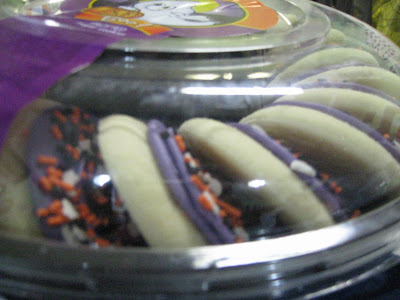
What I'm up against.

It shouldn't be this hard...
Last year, when Penn started preschool, I had some misgivings about the food he was being offered at snack-times. Those misgivings have blossomed into concrete-and-rebar road blocks over the course of the past 48 hours. What finally pushed me over the edge? Not sure. The Otter Pop incident was last month, and I spied the Skippy Peanut Butter on the counter a couple weeks back. The preschool kitchen is no stranger to trans-fat and sugar-saturated muffins, cookies, etc. I've sat on my hands all year, comfortable to be privately horrified, so why now? Maybe I'm just that slow. I suppose I finally took a minute to think. Anyway--today I brought in some "snack alternatives" for Penn, in a little container. Almonds, apriums, bananas to offer, instead of... what, exactly? This morning, "crackers" and "peanut butter" were set out for snack. Sounds benign, but I want Penn to take a break from Goldfish and Jif. (I cannot believe I have to say this out loud, or out blog, or whatever/wtF.) So now. I'm tasked with figuring out how to convey a set of standards, a set of guidelines, to help his (otherwise amazing) teachers keep him from eating junk. Don't feed Penn anything that isn't a whole food... don't let him have anything with added sugar... are these clear-cut enough parameters? I okayed cheese. But now that I actually think about this, I'm not sure cheese means cheese to everyone. If Fla-Vor-Ice made it through the castle wall, what's to stop Cheez Whiz? *strangled scream of frustration*
Does Penn ever eat processed food? Sure. But we, his parents, prefer to say when, how, and what. Unmitigated sugar intake leads to cravings for sugar, which leads to poor relationships with food. Poor food management is the reason for obesity (in 1/3 of Americans these days), inattentiveness, and myriad other maladies. The percentage of obese children in this country is higher than that of adults. Blah blah, everyone knows this, blah--but that means it's on us to teach the littles about food. It's our job to provide them with healthy stuff to munch. (Am I crazy? I feel like I'm in the twilight zone, with everyone insisting day is night and night is day.) Here we are, by the way, living in an educated, affluent part of California. Penn's school is private, rather expensive, and the kind of place that ought to know better than to serve kids a giant tube of frozen water and high fructose corn syrup. (Right???) Why, my boss rightly asks--why, oh, why are they feeding the children poison?
I don't know. And I suspect I'm going to make myself really unpopular, least of all with my poor son (who loves sugar just as much as the next human being). THIS SUCKS. It has been so much easier to roll my eyes and kvetch and not actually do anything. Packing date rolls and almonds and little carrot-chip-and-peanut butter sandwiches isn't hard to do, but it singles Penn out. And me. And now we're the hippies (we're the hippies?? Are you kidding me??) Did I mention I think this is ridiculous? On the bright side, the kid. My kid. Loves fruit and vegetables. He will survive. And it's summer. Apriums, berries, snap peas. Figs to the rescue.
This should be easy. This should be a no-brainer. I should be pulling myself up by the boot-straps. I should be in fine form (mountain pose, grin-and-bear-it, come on, Harv). I'm not.
This feels about as good as standing in the middle of the highway at dusk. Blinking, stupid, too scared to run or cry. xox

What I'm up against.
Friday, March 25, 2011
Control...or Not
So...there's probably no inherent, real significance to dropping a splotch of tofu dip on my laptop's control key. And yet. The tiny gerbil who powers the tiny metaphor generator in my head is really a very hardworking rodent.
Monday, March 21, 2011
Morning

Some days are bad, and some nights. And then you stretch, reach out a little. And someone precious to you reaches back, offers you a hug--long distance, impossible. And though you'd like the real hug, just the offer, so genuine, is enough to move you along for now. You dissolve a little, melting the fear. You sleep.
And in the morning, there's quiet on that long distance line. But the quiet isn't silence. It's just the quiet of two friends, lying in the grass together, holding hands maybe. Long distance, impossible. And yet, still somehow, together, staring up through leaves moving gently in a breeze, faces dappled by sunlight.
Saturday, March 5, 2011
Gratitude and Love
What do gratitude and love look like?
Sometimes, they don't look like bouncy, sunny, happy things particularly. Sometimes, they just look like the absence of fear, or shame, or judgment. (But there's nothing "just" about that, is there?) Sometimes, they just look like you, understanding that who you are in the world and the choices you make are both okay. More than okay, maybe. Even when you and your choices are difficult, messy, painful.

cherry blossoms
Sometimes, they don't look like bouncy, sunny, happy things particularly. Sometimes, they just look like the absence of fear, or shame, or judgment. (But there's nothing "just" about that, is there?) Sometimes, they just look like you, understanding that who you are in the world and the choices you make are both okay. More than okay, maybe. Even when you and your choices are difficult, messy, painful.

cherry blossoms
Wednesday, January 19, 2011
•failing•
A failure is contingent. You have to attempt, in order to fail, and it is always so good to be attempting something. Failing means doing, trying, working. I live to fail--what better to remind me that all this (grand, sweeping gesture) is earned?
Don't let fear get in your way. Fail, damnit, then get up and fail again.
Nice idea, Harvey. Now, how about you take that pink machine out of the closet and clear off the sewing table you're currently using as a "desk"? That favorite pair of jeans won't repair themselves. xox
Don't let fear get in your way. Fail, damnit, then get up and fail again.
Nice idea, Harvey. Now, how about you take that pink machine out of the closet and clear off the sewing table you're currently using as a "desk"? That favorite pair of jeans won't repair themselves. xox
Subscribe to:
Posts (Atom)