I don't remember when I learned the word "forsythia," or when the Korean word or my friend's name fell from my memory. But every spring, I see the yellow blossoms and I think of her.


A year is long, and a year is no time at all—just a series of weeks, really, and those are just a series of days when it comes right down to it. And in the blink of an eye, the utterance of one sentence, the course of a day, a moment of insight, everything can change. The year and our lives turn on the smallest moments, singular points in time that may or may not be visible to us after the fact. They’re little cliffs, and we’re constantly leaping.
Leaping off of cliffs this year left me, as it always does, with work to do. There are always cliffs, and there’s always work to be done—but this year, the work in front of me is clearer than usual.
You know how some people choose a word for their year? Something they’d like to focus on, a concept or attitude they’d like to incorporate more fully into their lives. I imagine that when you make such a choice, you see your word everywhere, in everything; every moment becomes an opportunity to practice your word in some way, to draw your focus gently back to the growth you’d like to see in yourself, the work you’d like to be doing.
I’ve never done this. There are so many possible words to work with—which one to choose? Do I have to choose just one? The trick, of course, is to find the word that best works as an umbrella for all the things I’m feeling and thinking about.
There’s an Adrienne Rich poem called “This is My Third and Last Address to You,” and it’s quite long, but really, what I’ve always loved most in it are five stanzas somewhere in the middle. And if you are facing any sort of change or growth—especially if it’s the kind that makes you uncomfortable or impatient, this particular stanza may speak to you as it always does to me:
force nothing, be unforced
accept no giant miracles of growth
by counterfeit light
Is there a word that will stand in for that stanza, that will serve as the umbrella word for my year? Patience is part of it, but I’m reaching for something deeper. A sort of quiet understanding and compassion for myself and others: We all take the time we take to get where we’re going, and we can’t be hurried along. Nor can we be stopped or slowed when movement and growth are really happening—and movement and growth are usually happening, right under the surface, even when we feel as if we’re slow as molasses. Slow is not stagnant.
There’s never any time to waste, and simultaneously, there’s always all the time in the world. A new year comes, just as they always do, right when it’s meant to. We may think we’re not ready, but we are. We may think we know what this new year will hold, but we never do. All we can do is adjust our focus once again, resolve to force nothing, and know that as long as we aren’t letting ourselves stagnate in fear or resistance, then we’re growing, moving forward, making progress. The work we each have to do, when we take the time to know what it is and learn how we might go about it, can be joyful and fulfilling—even in the moments when it’s hard or painful. Because deep work, the work of growth and change, is always as complicated and nuanced as an entire year.
And somewhere in this year, as in every other year, there will be those moments when the world shifts, and everything changes, and we leap off our little cliffs, and that joyful, painful work we’ve been doing (slowly, so slowly) lands us somewhere we really never expected.
***********
The initial breakage is utter chaos. Your feet are bare, and there you are, standing in the middle of shards, that cup of coffee you were so looking forward to splattered on the floor, the wall, the table and chair legs. Who knew liquid could travel so far propelled only by the force of a mug hitting the ground? Who knew the pieces of the mug could bury themselves in dark corners, under the china cabinet, in the next room over? Who knew a mug could break into so many individual pieces, each one a memory of the lovely thing you once had?
And that’s the tricky part—the way the mug’s pieces are suddenly so lovely to you. Suddenly, all you can see is the work and love that went into this handmade thing, the investment of time and energy at the wheel and hope in the firings, the beauty of the glaze.
Somehow, in your grief, you don’t remember the hairline fracture that ran through the whole thing—the flaw that meant it was simply a matter of time before the mug broke anyway.
********************
When a favorite mug of mine broke a few years ago, I was devastated. I guess that’s a little odd, but my feelings about mugs run deep—I’ve made many of the mugs I own, and when I'm in my active pottery-making mode, I am, in fact, a little obsessed with the making of them. And while this particular one wasn’t made by me, it was one I loved dearly, and I’m sure most people won’t exactly be able to relate to the level of grief I felt about breaking it. I cried a good bit. I kind of hated myself for losing my grip on the poor thing. And I couldn’t bear to throw out the pieces. I had no idea what I would do with them—the mug was far beyond any hope of repair—but I gathered up as many pieces as I could, washed them carefully, and set them in a bowl on my kitchen counter, where they stayed for about a year and a half.
Over the next few days, I came across a shard or two of the worst kind—the little slivers that get stuck in feet or fingers and make them bleed. There weren’t many left at all—we did a pretty good job cleaning them up. But the ones I found hurt a lot, and they made me so sad all over again.
The other night, I was looking for a photo to use as a new blog header, and I kept opening photographs that were just like those little slivers of stoneware—painful reminders of something I’ve shattered. Unlike the mug, this shattering was done consciously. And somehow, that makes the shards feel that much sharper.
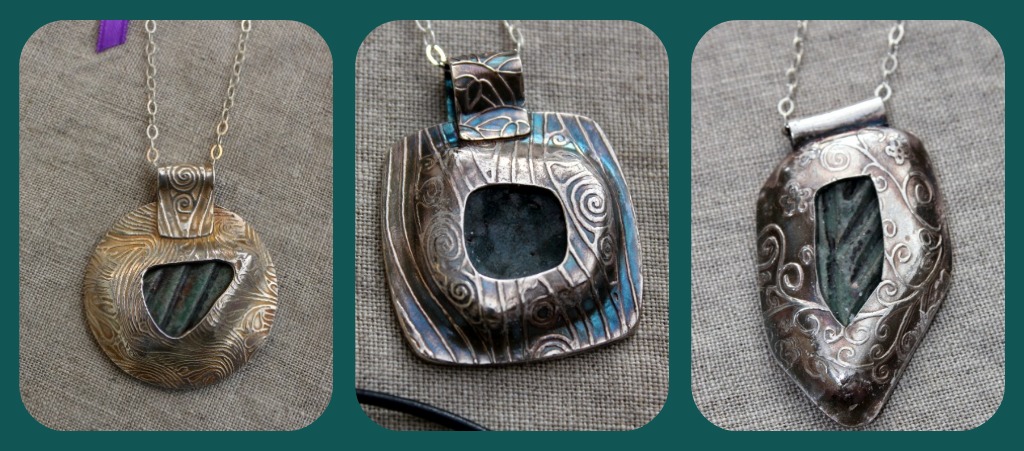
Eventually—just last fall—I had an epiphany about the shards of mug. It occurred to me that stoneware is fired well above the temperature at which I fire silver clay, which meant that I was easily able to incorporate those shards into my jewelry designs. I could create with this broken thing; I could transform the mug and my grief about it into something new and very beautiful.
Is grief always like that, on the other side? And is this what people mean when they say that you have to sit with grief? That you have to clean the shattered pieces, gather them into a bowl, and go about your life as best you can, taking whatever comfort you can manage in the knowledge that you needn’t throw out the pieces if you don’t want to?
And then one day, when you’ve seen that bowl so often that you’ve almost reached the point of no longer seeing it, you’ll glance in its direction, and you’ll see it as if for the first time, and with enormous joy, you’ll realize exactly what you saved those pieces for.


